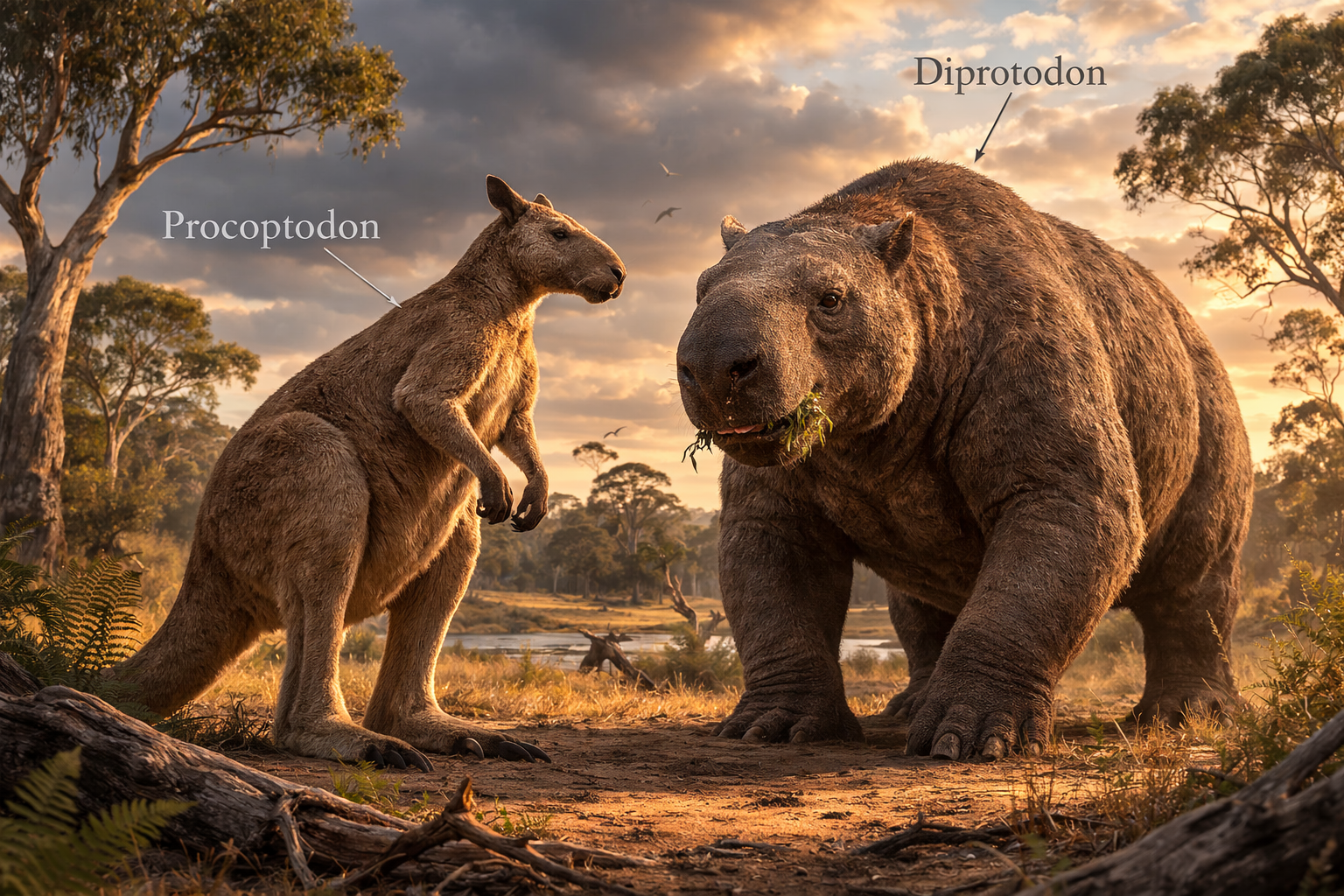
Diprotodon and Procoptodon were dominant Australian Pleistocene megafauna. They were the original custodians of Australia. Diprotodon was the largest-known marsupial (rhino-sized, about 3 tonnes), while Procoptodon was the largest-known kangaroo (2m tall, 200kg). Both were herbivores that first appeared 2.5 million years ago and lived until roughly 40,000–11,700 years ago.
Diprotodon (Giant Wombat)
The Diprotodon (meaning 2 protruding teeth) was the predecessor of the modern wombat. It grew to 4m long and 1.8m high at the shoulder. It was a massive wombat-like creature with extremely strong robust legs. As a herbivore, it fed on twigs, leaves, and shrubs whilst grazing. It lived in herds and migrated seasonally.
Procoptodon (Short-faced Kangaroo)
Living in the Pleistocene era, it stood around 2-3m tall, with a reach of up to 1m above this. It grazed on high-level shrubs using long arms to pull branches. Instead of hopping, it is believed to have walked on its hind limbs. Appearance-wise, it had a flat face, forward-facing eyes, and a single claw on each foot.
What caused their extinction?
Many modern researchers and evidence suggest that it was due to the arrival of early Aboriginal Australians (via the land bridge from India and South East Asia). With their hunting and the use of fire to manage their environment, it would probably have contributed to the extinction of the megafauna. See a history of mammalogy by Tim Flannery.
Do we run tours to see the early kangaroos and wombats?
No. Given that they died out at least 11,700 years ago, this is no longer possible. However, we do run Australia’s best kangaroo and wombat tours.

About the author